Blog
Order Tapas at Spanish Taverns with Michel

A good tapas bar can look unassuming from the street: a few tables, a handwritten board, perhaps an older gentleman discussing football at the counter. But when you order tapas at Spanish taverns with someone who knows the people, the produce and the stories behind the plates, an ordinary evening becomes a proper introduction to Marbella.
I am Michel Ende, and food has shaped my working life for more than 35 years. I have called Marbella home for over two decades, long enough to see trends come and go, to build friendships with bar owners and market vendors, and to learn that the city’s most memorable flavours are rarely found by simply following the busiest terrace.
For me, a food tour is never only about what is on the plate. It is about the family recipe that has survived three generations, the reason an anchovy tastes different here, the old street that once led towards a trading route, and the small rituals that make a tavern feel like the neighbourhood’s living room.
Meet Michel, Your Marbella Food Tour Guide
Before guiding guests through the lanes of the Old Town, I spent decades in catering. That background taught me to notice the details: the quality of olive oil, the balance in a cold soup, the freshness of a fried fish, and the care hidden inside a seemingly simple tapa. It also taught me that hospitality is not performance. It is making people feel welcome, comfortable and looked after.
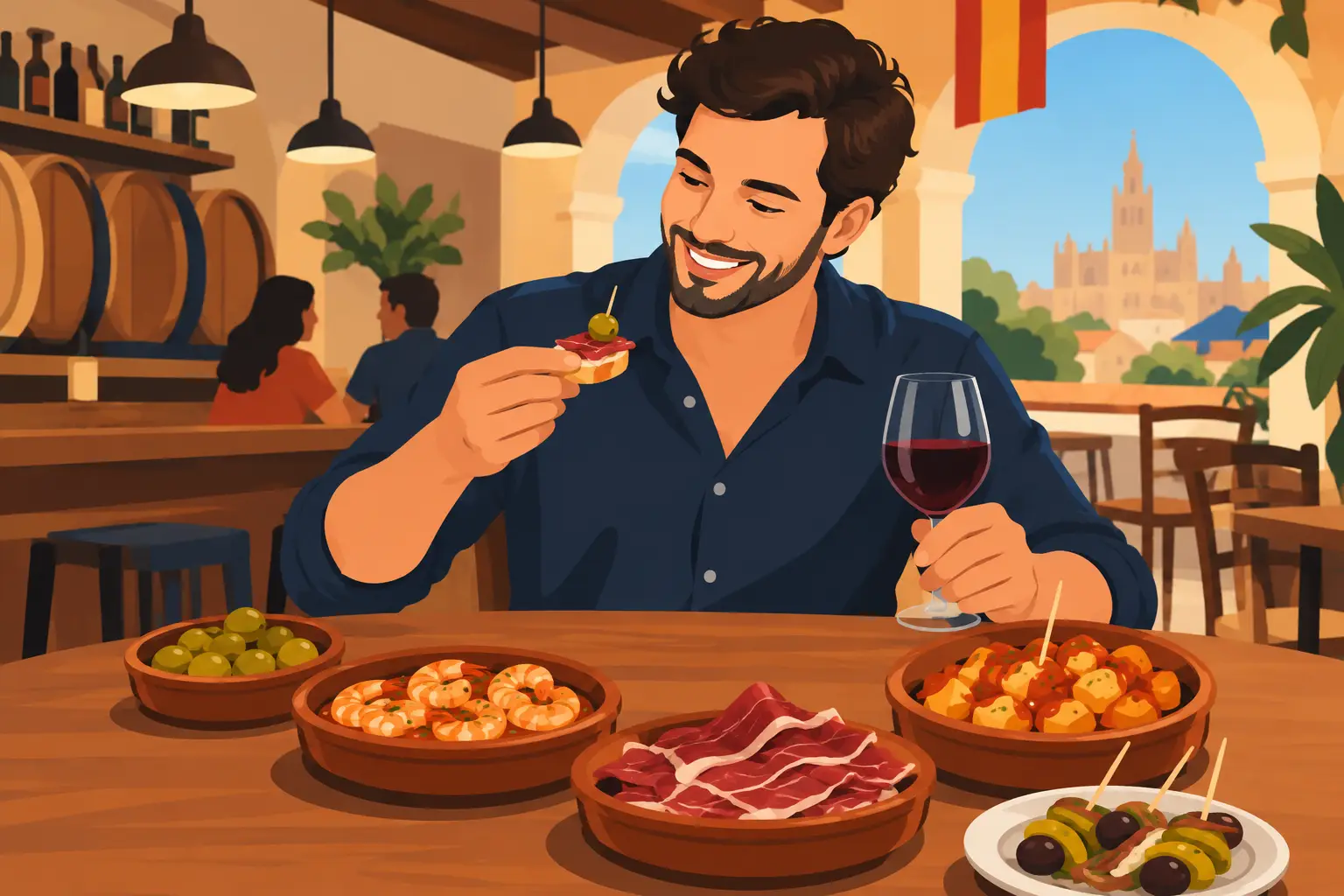
When I arrived in Spain, Andalusian food gave me a new language for those values. Here, a meal has a rhythm. You may begin with a chilled glass of local wine, order one or two small plates, pause for conversation, then decide together what should come next. There is no need to rush towards a long list of dishes. The pleasure is in following the moment.
Over the years, I have become deeply fascinated by the culinary history behind that rhythm. Andalusian cooking carries traces of Moorish agriculture, Mediterranean fishing traditions, mountain village preservation methods and the humble ingenuity of family kitchens. Almonds, citrus, saffron, sherry vinegar, cured pork, aubergines and olive oil are not just ingredients. They are clues to the region’s past.
That is what I love sharing with travellers. You should leave with a full stomach, certainly, but also with a clearer sense of why the food tastes as it does and why the setting matters.
Why Order Tapas in Spanish Taverns, Not Just Restaurants?
A Spanish tavern is often the best place to understand the social side of tapas. These are spaces made for conversation: locals stopping in after work, friends sharing a quick bite before dinner, and regulars who need no menu because the person behind the bar already knows their favourite order.
The menu may be short, seasonal or spoken rather than printed. One day, the standout dish might be tender artichokes with ham; another, it could be a stew made from a recipe the kitchen has cooked for years. This is part of the charm, but it can also be confusing for visitors. Which house special is worth trying? How much should you order? What is genuinely local, and what has merely been designed for passing tourists?
A guide helps you read the room without taking away the spontaneity. I introduce the customs, explain the ingredients and make sure everyone can relax into the experience. If you are adventurous, we can talk about the dishes that may not appear on the usual holiday menu. If you prefer familiar flavours, there is no judgement and no pressure. Great tapas should be joyful, not a test of courage.
Dietary needs deserve the same care. Vegetarian, pescatarian and many other requirements can often be accommodated when a visit is planned thoughtfully. The key is honest communication and choosing places where the kitchen takes pride in looking after its guests.
The Difference Between a Tapa and a Meal
Tapas are not one fixed category of food. Depending on the tavern, they may be a small complimentary bite with a drink, a modest portion to share, or a carefully prepared dish that deserves your full attention. In Marbella, as elsewhere in Spain, the meaning can vary from place to place.
That flexibility is why ordering well matters. A table of two may enjoy a sequence of lighter dishes before choosing something warmer and more substantial. A family or small group can share more broadly and compare flavours. There is no single correct formula, although ordering everything at once is often less satisfying than allowing the evening to unfold.
Taste Marbella Reviews: Why Guests Mention Michel
For several years, I worked as head tour guide at Taste Marbella, welcoming guests who wanted more than a quick tasting stop. Many generous travellers mentioned me by name in their five-star reviews. I am proud of those comments not because they are a trophy, but because they reflect the things I care about most: making guests feel at ease, sharing knowledge without sounding like a lecture, and showing the city with genuine affection.
The historic, deep-dive style that many guests enjoyed on those earlier walks is still at the heart of my work. Today, travellers can book directly with me through Marbella Flavours for a 3.5-hour Tapas & Educational Tour shaped around food, history and the quieter details that bring the Old Town to life.
I do not believe a guide should simply point at a building, deliver a fact and move on. A place becomes memorable when its stories connect. A narrow lane is more interesting when you understand the centuries of trade and settlement behind it. A plate of local cheese means more when you know something of the landscape, animals and producers that made it possible.
The Best Tour Guide in Marbella Old Town Is the One Who Listens
People sometimes search for the “best tour guide Marbella Old Town” before they arrive. It is a sensible question, yet the best fit depends on what you want from your holiday.
If you only want a list of places to eat, you can find one almost anywhere. If you want loud entertainment or a large party atmosphere, a small, story-led food walk may not be your ideal choice. But if you are curious about local life, enjoy asking questions and want to eat in places with character, the experience becomes far more personal.
I keep groups intimate because it changes everything. We can hear one another. There is time to notice the tiled doorway, the church bell in the distance, the changing aroma as we pass from a bakery towards a tavern kitchen. Guests can ask about wine, food traditions, Spanish habits or the history beneath their feet. Nobody needs to fight for the guide’s attention.
The same approach matters for private tours. A couple celebrating an anniversary may want a slower, wine-focused route. Friends might be keen to try a wider variety of dishes. A family may need an earlier pace and food choices that suit everyone. The route should serve the people walking it, not the other way round.
What I Hope You Take Home
The finest souvenir from Marbella is not always an object. It may be the taste of tomato dressed simply with excellent olive oil, the surprise of a local wine you had never heard of, or the confidence to step into a tavern on your own and order with curiosity.
I hope you remember the laughter around the table as much as the food. I hope the Old Town feels less like a pretty backdrop and more like a place with a pulse – shaped by its residents, its shopkeepers, its cooks and its long history.
So when you are ready to leave the obvious route behind, come hungry and bring your questions. The best tapas are waiting, but the stories that surround them are what make the evening stay with you.